


EMCC Provides Electromagnetic Field Simulation Capabilities for EMC and Aircraft Design

EMCC, a provider of electromagnetic compatibility (EMC) testing, measurement, simulation, and certification support services for complex electronic and aerospace systems, provides electromagnetic field (EM) simulation capabilities, which complement its EMC testing services by enabling the evaluation of electromagnetic effects, design variants, and system modifications during early development stages. The approach allows design assessments and optimization work to be carried out before physical prototypes are available.
According to EMCC, its simulation activities are supported by theoretical expertise, long-term experience in EMC measurements, and routine testing of complex systems. These capabilities enable plausibility assessments and cross-validation of simulation results against measurement data.
The company states that EM simulation can help reduce development costs, accelerate development programs, support early risk assessment, and shorten project timelines. Typical applications include theoretical and numerical analysis of electromagnetic coupling effects, evaluation of protection measures, design reviews, and engineering support activities. Key focus areas include High Intensity Radiated Fields (HIRF), lightning effects, nuclear electromagnetic pulse (NEMP), and antenna analysis.
HIRF Simulation
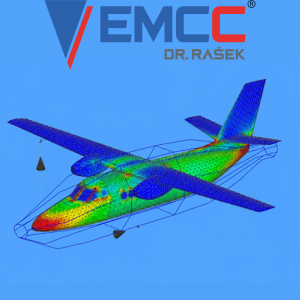
EMCC applies numerical simulations to assess the effects of High Intensity Radiated Fields throughout the aircraft design process. During early development, simulations can be used to estimate internal electromagnetic environments. At later stages, they can evaluate the impact of design modifications and support measurement campaigns required for HIRF certification.
EMCC Provides Electromagnetic Field Simulation Capabilities for EMC and Aircraft Design
Contact EMCCons DR. RAŠEK GmbH & Co. KG to learn more.
The company also uses simulation to examine aircraft exposure under incident angles that may not be covered by ground testing and to compare differences between ground-based measurement setups and operational flight, takeoff, and landing conditions.
Antenna Characterization
EMCC performs antenna simulations and characterization across intended frequency ranges. These analyses are used to determine parameters including beamwidth, radiation patterns, side lobes, antenna factors, and antenna gain.
Lightning Effects Analysis
EMCC also conducts simulations related to lightning effects on aircraft. Using CAD drawings and other design information, the company can estimate lightning current distribution within aircraft structures and determine expected transient levels at interfaces connected to electronic systems.
According to EMCC, these simulations can be applied during early design phases, following design modifications, or as part of formal aircraft certification activities, providing insight into potential lightning-related electromagnetic effects before physical testing is completed.
EMCC Provides Electromagnetic Field Simulation Capabilities for EMC and Aircraft Design
Contact EMCCons DR. RAŠEK GmbH & Co. KG to learn more.

Related News
Latest News

Technical Articles
Login to EMC Directory to download datasheets, white papers and more content.

Create an account on EMC Directory to get a range of benefits.
 Please wait...