


Dipole Antenna Length Calculator
Enter the value of operating frequency to calculate the Dipole length.
Result
- Total Length of Dipole(L)Feet
- Length of Each Dipole(E)Feet
What is Dipole Antenna Length?
Dipole antenna length refers to the total physical length of a half-wave dipole antenna required to operate efficiently at a specific frequency.
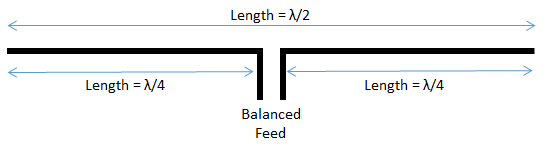
A dipole antenna typically consists of two equal conductive elements connected to a transmission line. The total length of the antenna is usually designed to be half of the signal wavelength (λ/2) at the desired operating frequency.
When the antenna length matches this half-wavelength condition, the antenna becomes resonant, allowing it to efficiently radiate and receive electromagnetic energy.
The correct dipole length is important because it directly affects:
- Antenna resonance
- Radiation efficiency
- Impedance matching
- Signal strength and performance
Uses of Dipole Antenna Length
Determining the correct dipole antenna length is important for designing antennas used in many RF systems.
Common uses include:
- Designing antennas for wireless communication systems
- Building radio transmission and reception antennas
- Creating reference antennas for RF measurements
- Optimizing antenna performance for specific frequencies
- Ensuring proper resonance and impedance matching
Accurate dipole length calculation ensures that the antenna operates efficiently at the intended frequency.
Dipole Antenna Length Calculation
The dipole antenna length is calculated by first determining the wavelength of the signal using the operating frequency.
Since a half-wave dipole antenna operates at half of the signal wavelength, the total antenna length is calculated as:
- Convert frequency to wavelength.
- Divide the wavelength by two to obtain the dipole length.
This calculation allows engineers and designers to determine the optimal antenna size for a given RF frequency.
Wavelength Equation:
λ = c / f
Dipole Antenna Length Equation:
L = λ / 2
Where
λ = Wavelength (meters)
c = Speed of light (≈ 3 × 10⁸ m/s)
f = Frequency (Hz)
L = Total length of the half-wave dipole antenna (meters)
Applications in EMC
Dipole antennas are widely used in Electromagnetic Compatibility (EMC) testing because of their predictable radiation characteristics and well-defined performance.
In EMC laboratories, dipole antennas are used for:
- Radiated emissions measurements
- Radiated immunity testing
- Antenna calibration
- Field strength measurements
- Reference antennas for standard EMC tests
Due to their simple structure and stable radiation pattern, half-wave dipole antennas serve as standard reference antennas for EMC measurements and RF system validation.
Related Calculators
- Far Field Distance Calculator for Dipole and Log Periodic Antennas
- Far Field Distance Calculator for Horn Antennas
- Antenna Factor Calculator
- Antenna Half Power Beamwidth (3dB Angle) Calculator
- Free Space Path Loss Calculator
- Received Field Intensity Calculator
- Antenna Beamwidth Coverage Calculator
- Antenna Spot Size Calculator
- Antenna Distance Calculator
- Antenna Near Field & Far Field Distance Calculator
Other Calculators
- Field Strength Calculator
- Required Amplifier Power for Desired Field Strength
- Amps to dBm Calculator
- Antenna Factor Calculator
- Antenna Near Field & Far Field Distance Calculator
- dBµV/m to V/m Calculator
- Far Field Distance Calculator for Horn Antennas
- Received Field Intensity Calculator
- Received Power Density Calculator
- Required Antenna Gain for Desired Field Strength
Login to EMC Directory to download datasheets, white papers and more content.

Create an account on EMC Directory to get a range of benefits.
 Please wait...